unique:
---
Small Language Model
With the rise of generative AI systems like OpenAI's ChatGPT or Google's Gemini, I've become particularly interested in how they actually work. A quick search reveals that these systems are built on what's called a 'large language model' or LLM for short. An LLM is essentially a huge neural network, which is a mathematical model inspired by biological brains, that can be trained on massive amounts of data to acquire a sort of 'natural understanding' of what it's shown. Neural networks are used for things like classification of handwritten letters, face detection in images, and of course, language prediction in the case of LLMs.
But even knowing that, the question remains, how
exactly do you go from an input string like
High-Level Overview
At a high level, the whole system can be split into two major parts. First, the training of the model: This is where it 'learns' from existing data (in our case pre-written text). Second, the generation using the trained model: This is where the model takes an input (a seed string) and produces a continuation based on what it learned. However, at no point does the model actually handle bare text. Instead, everything is broken down into smaller parts, called token. A token can be anything from multiple words to a single character. Try clicking the 'toggle token' button in the demonstration above to see exactly how text is split.
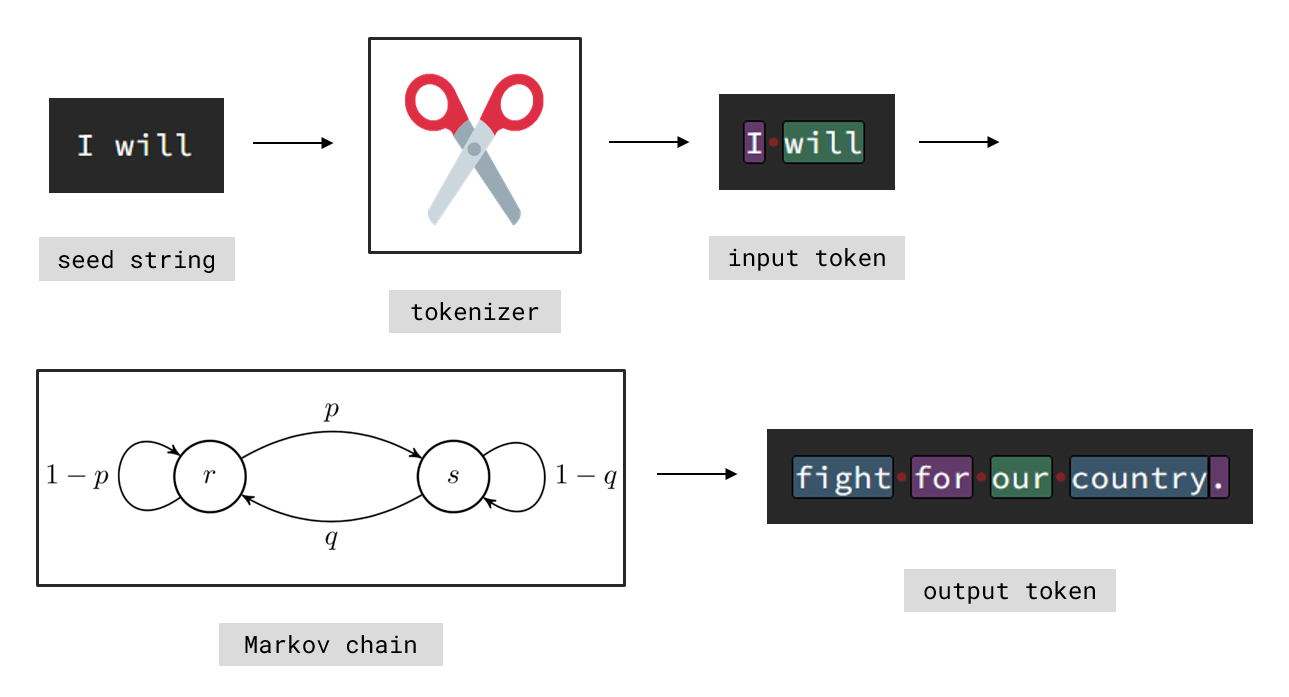
Conceptual generation process of a SLM.
To generate a fitting continuation of
Understanding the training process requires looking at how a Markov chain can even 'learn' to predict token sequences. Recall, a Markov chain is a stochastic process \(X_\mathbb{N} \subset S\), with its state space \(S\), such that \[ P(X_{n+1} = s \,|\, X_n,\ldots,X_1) = P(X_{n+1} = s \,|\, X_n) \] holds for all \(s \in S\). This means the chain only cares about its current state and not how it got there, which is both its biggest strength and its biggest limitation. If the state space is enumerable i.e. \(S = \{s_1,\ldots,s_m\}\) we define the transition probabilities \[ p_{ij} := P(X_{n+1} = s_j \,|\, X_n = s_i)\,. \] Notice how technically \(p_{ij}\) depends on \(n\), however in many applications (including ours) this is undesired. We therefore assume \(p_{ij} = \textit{const. } \forall n\) and call this property (time-)homogeneity. Finally all these probabilities are collected in a matrix \(\mathbb{P} := (p_{ij})_{ij}\) called the transition matrix. So how does this allow to 'learn' probable token succession? Consider this training text (from the model president-3, trained on U.S. inauguration speeches):
TXT
                        My fellow citizens: I stand here today humbled
                        by the task before us, grateful for the trust
                        you have bestowed, mindful of the sacrifices
                        borne by our ancestors.
First sentence of Obama's inauguration speech 2009.
To build a Markov chain we need two things: Its state space \(S\) and its transition
matrix \(\mathbb{P}\). The state space naturally arises from tokenizing the training
text (go ahead and try it) and treating each unique token as a state i.e.
PSEUDO
                        token = split input text
                        for i = 1,...,N do:
                            // find correct transition
                            indexA = index of token[i-1] in S
                            indexB = index of token[i] in S

                            // update corresponding weight
                            weight[indexA][indexB] += 1
General idea for training in pseudocode.
In our current example the first few weights are
Tokenizer
Appearing both in training and generation, the
tokenizer acts as the translation layer between human and model. Despite its
importance the actual logic behind it is quite simple: Define a list of characters
that seperate token e.g.
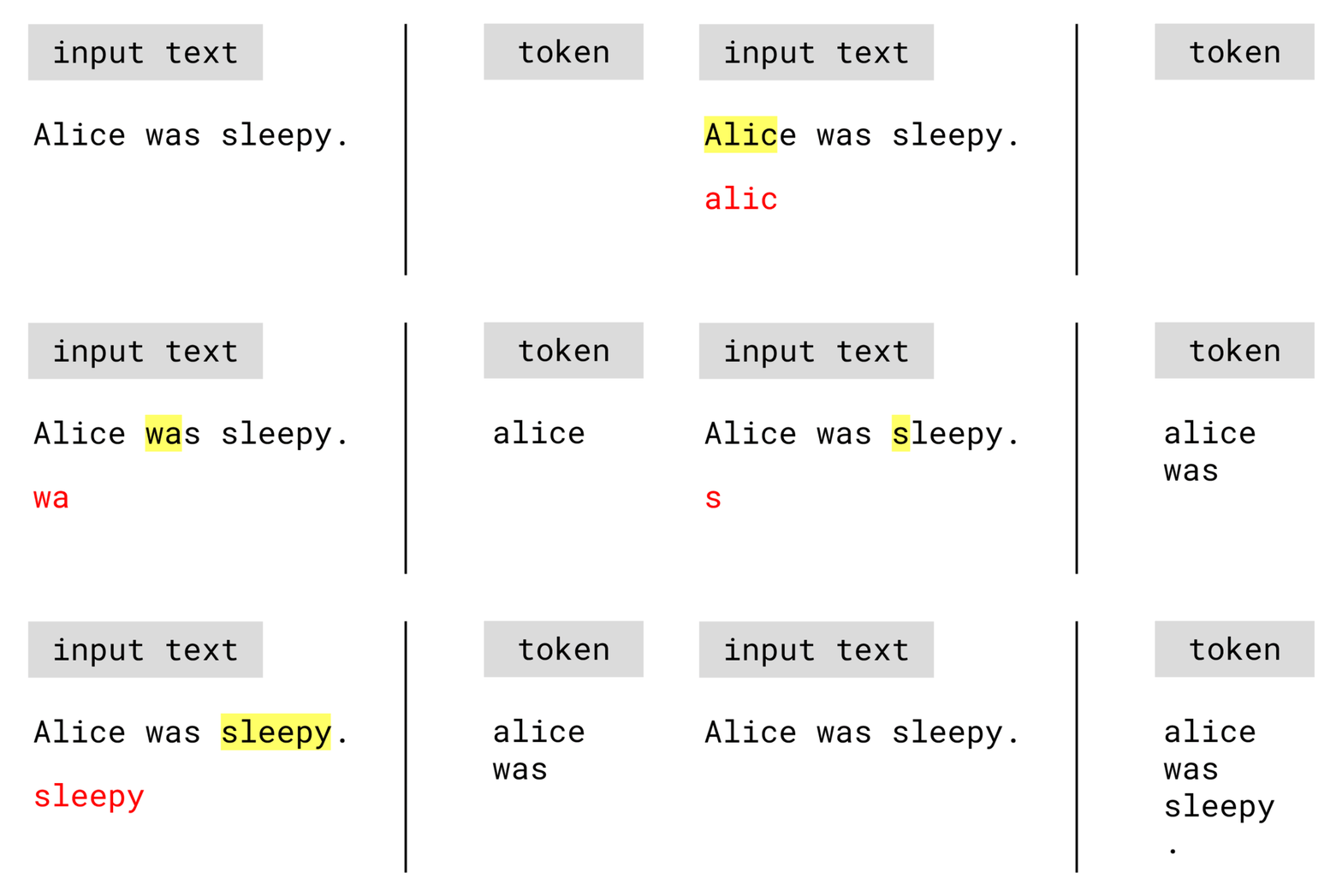
Tokenizer algorithm at work.
The actual code introduces a
JS
                        Tokenizer.split = function(input) {
                            /* clean up input first */
                            const output = []; let token = '';

                            // pushes current token then resets it
                            const flush = (str) => {
                                if (!str.length) return;
                                output.push(str); token = '';
                            };

                            // builds up token and checks when to flush
                            for (const char of input) {...}
                            return output;
                        }
High level from string input to token output.
A small helper function
JS
                        for (const char of input) {
                            /* skip ignored characters */
                            const fullWord = separator.includes(char);
                            const specChar = special.includes(char);

                            // special chars form token on their own
                            if (fullWord || specChar) flush(token);
                            if (specChar) flush(char);

                            if (!fullWord && !specChar) token += char;
                        }
Implementation of tokenizer algorithm.
Hashmap
Next we'll cover the concept of a hashmap. A hashmap is a data structure that
enables extremely fast lookups, even when handling millions of elements. This will
later be crucial for keeping our Markov chain efficient. JavaScript already provides a
built-in version of this via
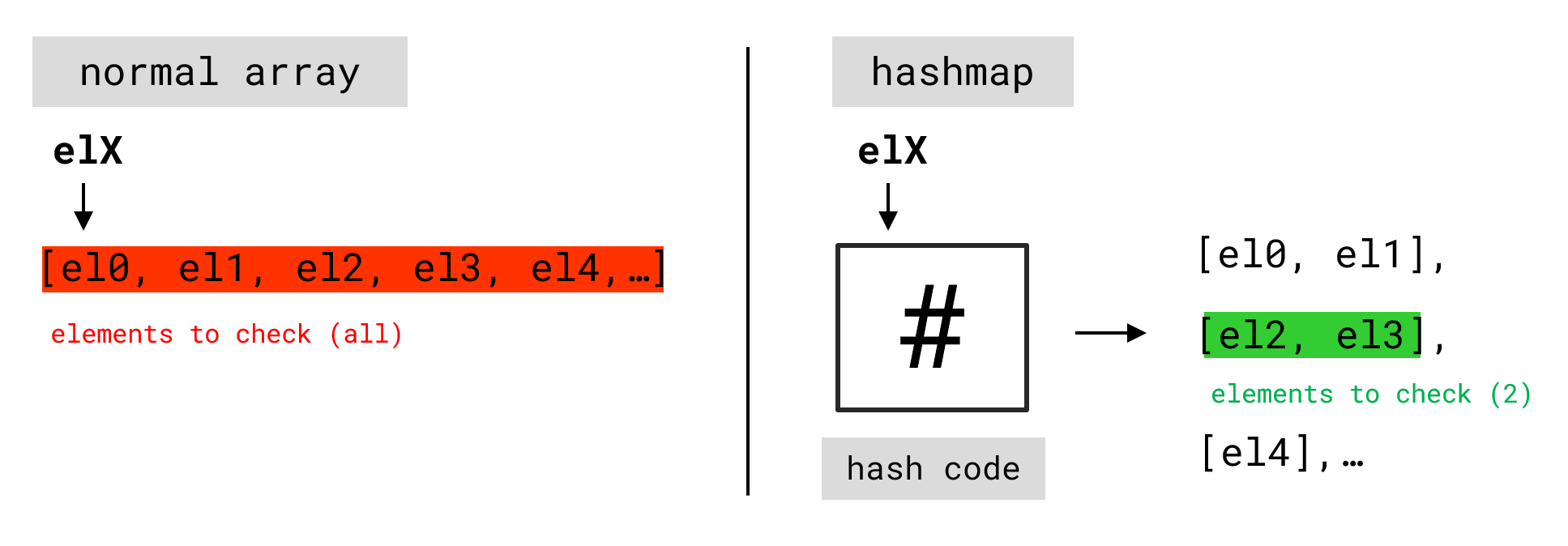
Classic array vs. hashmap.
The core component of a hashmap is the so-called
hash function. For our purposes, a hash-function \(h: \mathcal{X} \to
\mathbb{N}\) is a mapping between \(\mathcal{X}\), the set of all possible strings
given some alphabet \(A\), and \(\mathbb{N}\) (in practice often restricted to
32-bits, for example). The value \(h(\chi)\) is called the hash code of string
\(\chi\). There are many different ways to define such a function. For instance
\[ h(c_1 \cdots c_n) := \sum_{k \leq n} \iota(c_k) \]
where \(\chi = c_1 \cdots c_n\) is represented by its characters and \(\iota: A \to
\mathbb{N}\) is an embedding of the given alphabet into \(\mathbb{N}\) (e.g. using
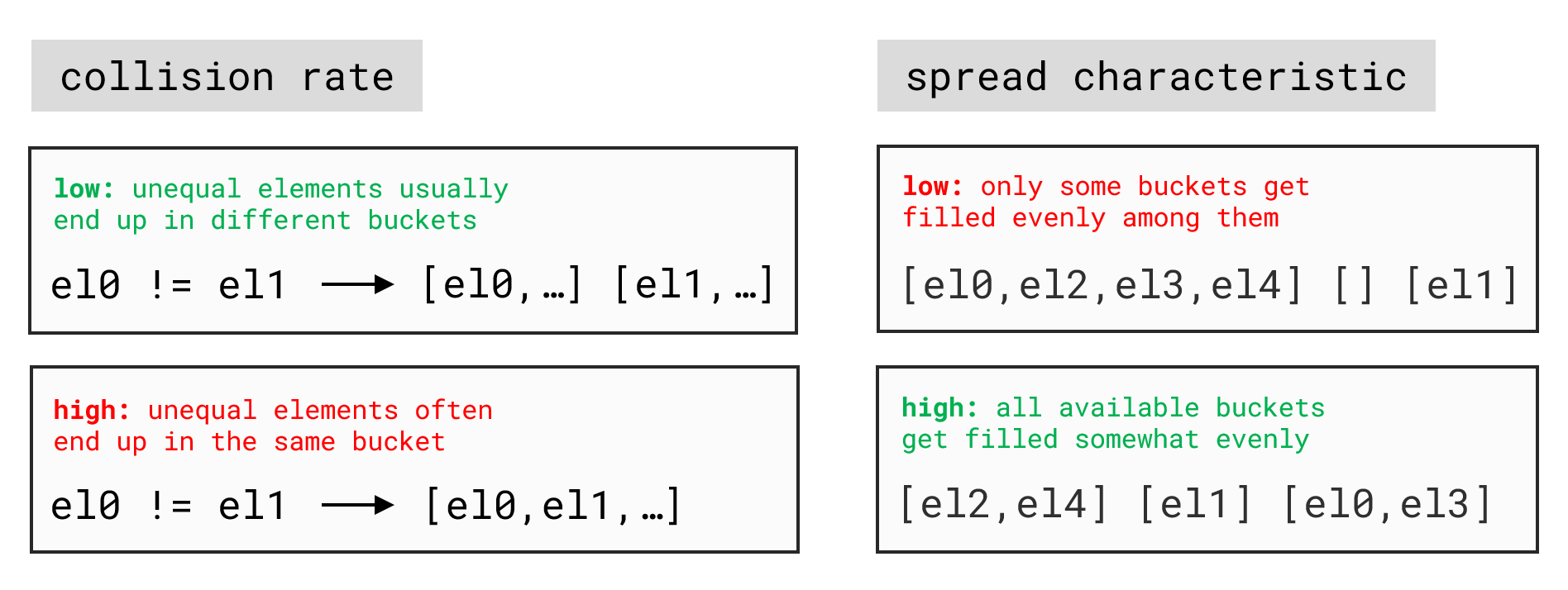
Collision and spread are related but not the same.
As our hash function, we'll implement the
JS
                        Hashmap._hashDJB2a = function(string) {
                            let hash = 5381;
                            for (let i = 0; i < string.length; i++) {
                                // multiply by 33 via left shift
                                hash = (hash << 5) + hash;
                                hash ^= string.charCodeAt(i);
                            }

                            // modulo 2^32 via unsigned right shift
                            return hash >>> 0;
                        }
Efficient implementation of DJB2a hash.
While the implementation overall is fairly straightforward, two clever details are
worth noting. First, multiplying by \(33\) can be done efficiently by shifting left by
\(5\) bits (equivalent to multiplying by \(2^5 = 32\)) and then adding the original
value once. Second, taking the remainder modulo \(2^{32}\) simply forces the hash to
an unsigned 32-bit integer, which in JavaScript can be achieved with the unsigned
right shift
From this we can introduce the
JS
                        Hashmap._index = function(ID) {
                            let index = this._hash(ID);

                            // modulo 2^k via bitwise and
                            index &= (1 << this._power) - 1;
                            return index;
                        }

                        Hashmap.find = function(ID, match) {
                            /* make sure ID is valid first */
                            return this._map[this._index(ID)].find(match);
                        }
Indexing and finding elements.
By keeping the size of
Proof. Let \((x)_2 = x_{n} \cdots x_1\) be an \(n\)-bit integer written in base
\(2\). Then taking the remainder modulo \(2^k\) for \(k \leq n\) simply gives the
lower \(k-1\) bits \(x_{k-1} \cdots x_1\). Equivalently
\[ x \wedge (2^k - 1) \,=\, x_{n} \cdots x_1 \wedge 0 \cdots 0 \underbrace{1 \cdots
1}_{k-1\,\text{times}} =\, x_{k-1} \cdots x_1 \]
where \(\wedge\) denotes the bitwise
Next we'll look at how elements are added to the hashmap. At first glance this seems
straightforward. Just hash each
JS
                        Hashmap.add = function(ID, el) {
                            this._map[this._index(ID)].push(el);
                            this._total += 1;

                            // trigger resize if N / M > alpha_max where
                            // N = total elements and M = total buckets
                            const load = this._total / (1 << this._power);
                            if (load > this.alpha) this._resize();
                        }
Adding an element might trigger a resize.
Markov Chain
As discussed, a Markov chain is defined by its state space \(S\) and the transition probabilities \(p_{ij}\) between those states. One way to think about this is a directed graph \((V,E)\), where each vertex represents a state \((V = S)\) and each edge \(e_{ij} \in E\) connects the \(i\)-th state to the \(j\)-th one with the weight \(\omega_{ij} = (N-1)p_{ij}\). This perspective not only works perfectly as the foundation for our implementation, but also provides a clear and intuitive way to visualize the structure of the chain.
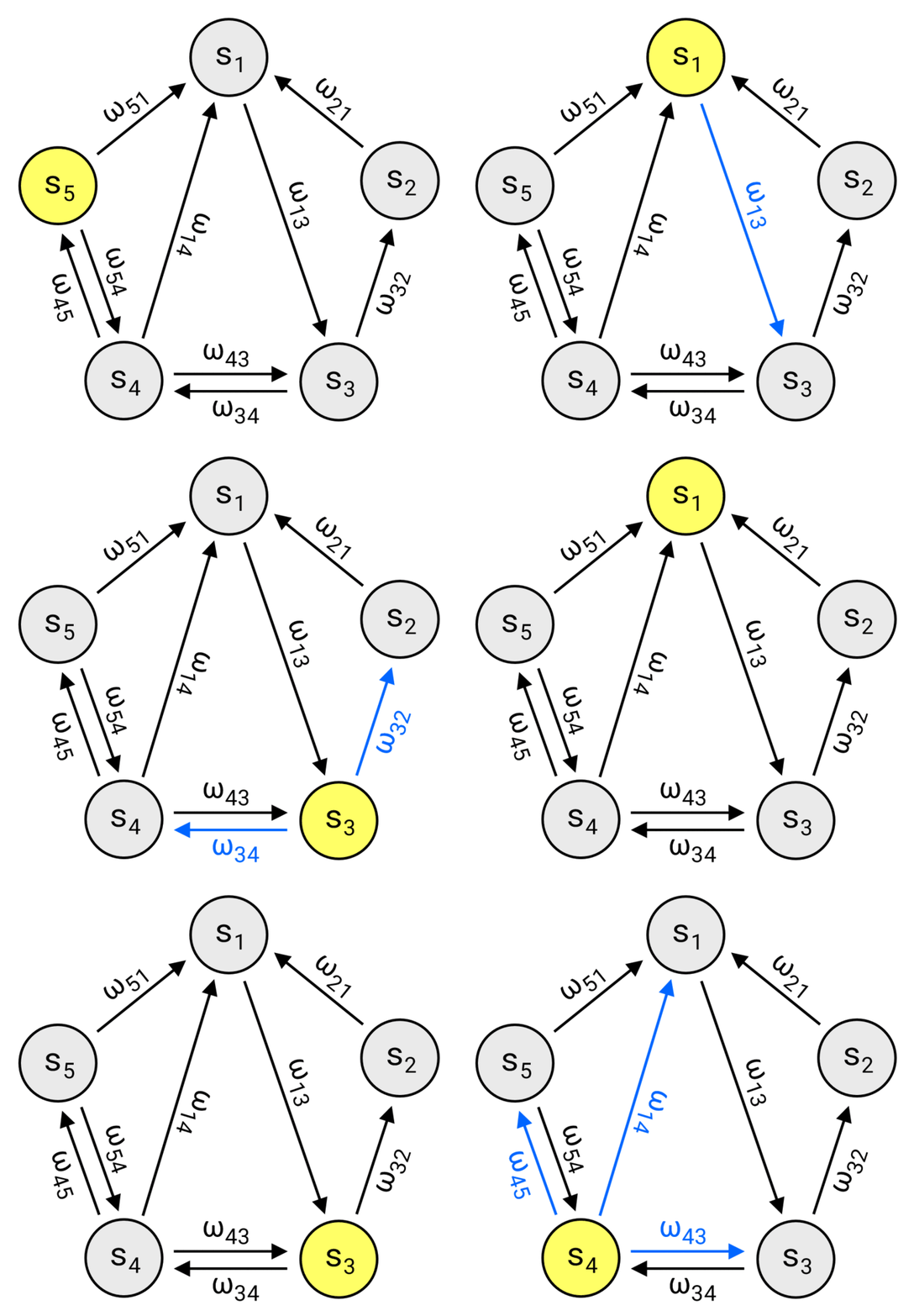
Walking the chain (only non-zero weights are shown).
To implement this structure, we begin by introducing two classes:
JS
                        Vertex.addEdge = function({ targetID, weight = 1 }) {
                            /* update total weight */
                            // if edge already exists just update weight
                            let edge = this._findEdge(targetID);
                            if (edge) { edge.addWeight(weight); return; }

                            // else create new edge and add it to _edges
                            edge = new Edge({ targetID, weight });
                            this._edges.push(edge);
                        }
Adding edges requires us to ensure uniqueness.
From here we can introduce the
JS
                        Chain.addVertex = function({ ID, edges = [] }) {
                            // if vertex already exists just update edges
                            let vertex = this._findVertex(ID);
                            const update = edge => vertex.addEdge(edge);
                            if (vertex) { edges.forEach(update); return; }

                            // else create new vertex and add it to _vertices
                            vertex = new Vertex({ ID });
                            const create = edge => vertex.addEdge(edge);
                            edges.forEach(create);

                            this._vertices.add(ID, vertex);
                        }
Adding vertices also requires extra care.
Notice how both, updating and creating an edge, simply mean to call
JS
                        Chain.nextState = function(/* --- */) {
                            /* handle undefined state */
                            /* define random integer */
                            const pivot = randInt(this._state.weight);
                            let threshold = 0;

                            // pick random edge according to their weights
                            // and advance current state to target vertex
                            for (const { weight, targetID } of this._state.edges) {
                                // update threshold with weight then check pivot
                                if ((threshold += weight) > pivot) {
                                    this._state = this._findVertex(targetID);
                                    return this._state;
                                }
                            }
                        }
Selecting a new state by summing up weights.
Training & Generating
Before moving on, we'll introduce a concept called context depth. So far, we've only discussed handling sequences of individual token. If you try setting the context depth in the demo to 'low' and generate some text, you'll notice that much of it turns out to be semantic nonsense. However this is expected, as a simple Markov chain has no ability to 'learn' anything beyond statistical token succession. Still, a simple generalization of what we've done so far can help mitigate this limitation.
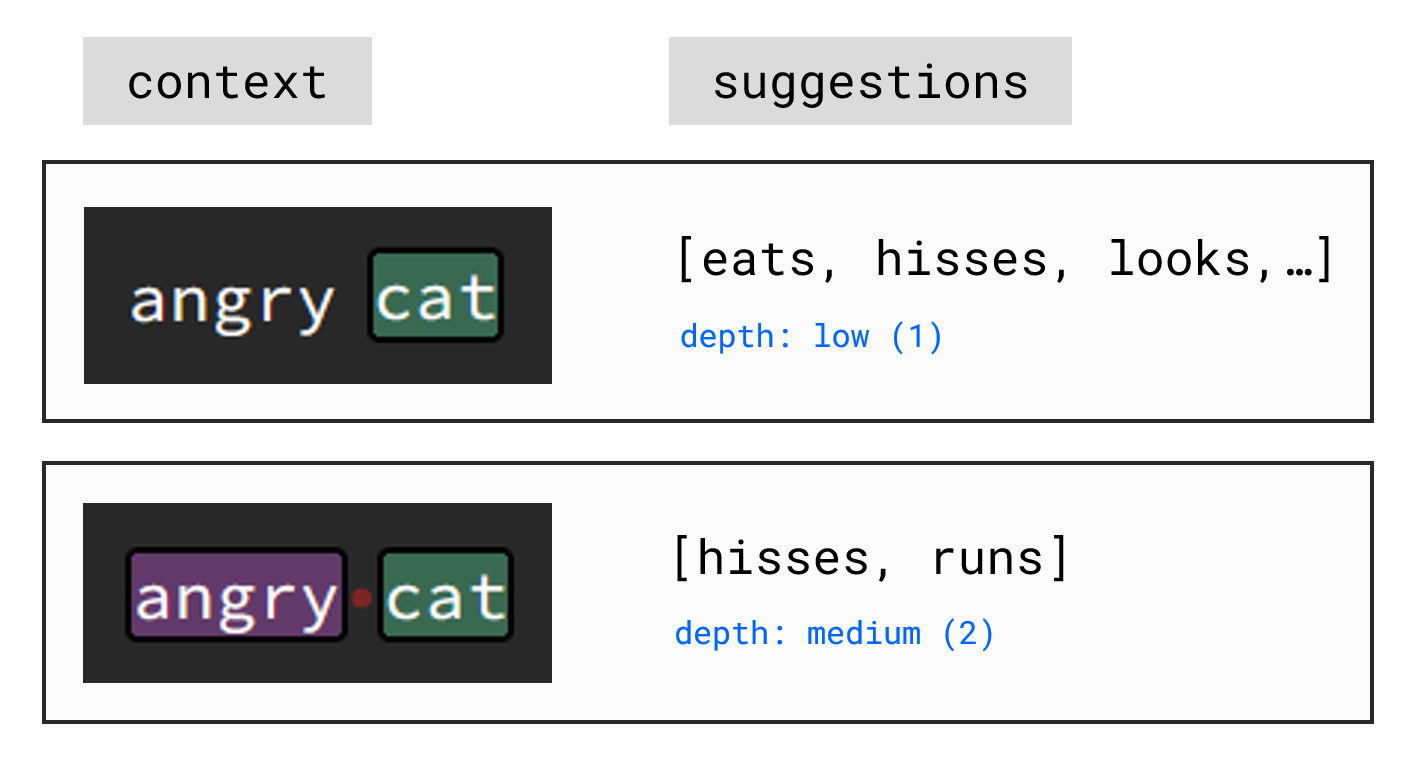
Deeper context allows for better suggestions.
Instead of treating each unique token as an individual state, we can group multiple
token together to form a single state. For example, where a simple training text like
JS
                        Chain._depthID = function(token, depth, i) {
                            return token.slice(i, i + depth);
                        }
Generalized IDs consist of multiple token.
Training a complete model therefore involves creating multiple Markov chains with
different context depths. To build up a chain, first tokenize the input text and then
iterate over the resulting token list. At each step, add a vertex of
JS
                        Chain.trainFrom = function(token, depth = this.depth) {
                            /* handle mismatched depth */
                            const train = (depth) => {
                                const ID = (i) => this._depthID(token, depth, i);

                                // iterate token list and create vertices accordingly
                                for (let i = 0; i < token.length - depth; i++) {
                                    const edges = [{ targetID: ID(i + 1) }];
                                    const vertex = { ID: ID(i), edges };
                                    this.addVertex(vertex);
                                }
                            }

                            // create a separate markov chain for each depth
                            do train(depth); while (--depth > 0);
                        }
Training chains with different context depths for one model.
Notice that, similar as before, we don't need to worry about whether a given vertex
already exists. Updating and creating a vertex are both handled automatically by
Generating output token from a given list of seed token is done by first deriving an
initial state from the seed and then repeatably calling
JS
                        Chain.generate = function(
                            { seed, length, depth = this.depth, /* --- */ }
                        ) {
                            /* handle mismatched depth */
                            const output = [];

                            // 1. try to increase currently used context
                            ...
                            // 2. if max context generate until length = 0
                            ...
                            // 3. else add one new token to seed and retry
                            ...

                            return output;
                        }
Conceptual steps for generation from given seed.
Since not every seed will necessarily lead to a state with the desired
JS
                        // 1. try to increase currently used context
                        let context = Math.min(seed.length, depth);
                        let vertex = {};
                        do {
                            const i = Math.max(seed.length - context, 0);
                            const ID = this._depthID(seed, context, i);

                            // if ID is empty get random vertex instead
                            if (!ID.length)
                                vertex = this._vertices.getRandom(depth);

                            else vertex = this.setState(ID);
                        }
                        // pre-decrement to not include depth = 0
                        while(!vertex && --context > 0);
Constructing IDs of decreasing depth to find valid initial state.
Once the maximum
JS
                        // 2. if max context generate until length = 0
                        if (context == depth) {
                            while(length-- > 0 /* --- */) {
                                const vertex = this.nextState();
                                const token = vertex.ID.last();

                                output.push(token);
                                /* additional scaffolding */
                            }
                        }
Generating new token by walking the chain.
Finally, if the initial context search fails to result in a state of the desired
JS
                        // 3. else add one new token to seed and retry
                        else {
                            // context + 1 since its decremented once extra
                            const vertex = this.nextState(context + 1);
                            const token = vertex.ID.last();
                            output.push(token);

                            // include new token and retry increasing depth
                            const newSeed = [...seed, token]; length--;
                            const subset = this.generate(
                                { seed: newSeed, length, depth, /* --- */ });
                            output.push(...subset);
                        }
Recursively retrying generation with new seed.
Uniqueness Score
As already mentioned, all a Markov chain can really 'learn' is the statistical
succession of token. This means that if our training data contains the phrase
Consider a Markov chain defined by its state space \(S\) and the transition probabilities \(p_{ij}\). Our goal is to find a function \(\phi : S^{n+1} \to [0,1]\) such that 'mostly unique' sequences map close to \(1\), while 'mostly derived' ones map close to \(0\). For any state sequence \(s_0,\ldots,s_n \in S\) define \[ \phi_k := 1 - p_{k-1,k} = 1- \frac{\omega_{k-1,k}}{\sum_j \omega_{k-1,j}} \,.\] If the transition \(s_{k-1} \to s_k\) is unlikely, \(\phi_k\) will be close to \(1\). If it is common, \(\phi_k\) will be close to \(0\). The most natural way to combine the values \(\phi_1,\ldots,\phi_n\) into a single measure \(\phi(s_0,\ldots,s_n)\) would be to take their average. However, if the sequence consists of mostly derivative blocks, where unique transitions only happen between them, the average becomes highly skewed and fails to represent the overall derivativeness of the sequence accurately.
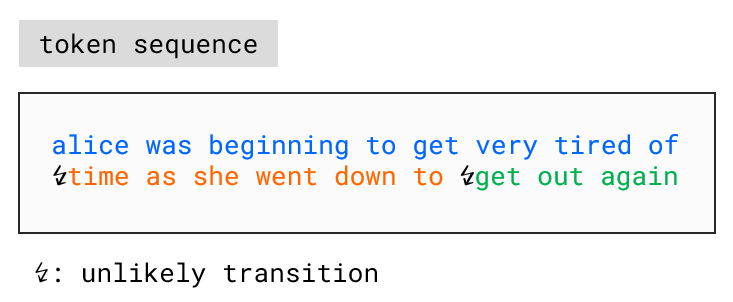
Few unlikely transitions can skew the average greatly.
A better approach could be to use the median, that is, the middle value of all sorted
\(\phi_k\). Unlike the average, the median is resistant to skewing from a few highly
unusual transitions. However, it can also be too inert: When the sequence consists of
many short but mostly derivative blocks separated by unique transitions, the median
would likely not reflect this at all, since it would remain dominated by the frequent
common transitions within those blocks. A simple and practical solution to this is
simply combining both, average \(\overline{\phi}_n\) and median \(\widetilde{\phi}_n\)
as follows
\[ \begin{align} \phi(s_0,\ldots,s_n)\, &:=\, (1 - \alpha)\, \overline{\phi}_n \,+\,
\alpha\, \widetilde{\phi}_n \\[5px] &=\, \frac{1 - \alpha}{n} \sum_{k} \phi_k \,+\,
\frac{\alpha}{2}\, \Big[\phi_{\big(\lfloor \frac{n+1}{2} \rfloor\big)} +
\phi_{\big(\lceil \frac{n+1}{2} \rceil\big)}\Big] \end{align} \]
where \(\alpha \in [0,1]\) and \(\phi_{(k)}\) is the \(k\)-th sorted value. I chose
\(\alpha = 0.6\), giving the median a slightly stronger influence than the average.
Implementing the final formula for \(\phi(s_0,\ldots,s_n)\) is straightforward and
mainly involves computing each \(\phi_k\) i.e. the
JS
                        const uniqueness = (ID1, ID2) => {
                            const edges = this.getEdges(ID1);

                            // corresponds to omega_(k-1)_k
                            const target = (edge) => edge.targetID.equals(ID2);
                            const choiceWeight = edges.find(target)?.weight || 0;

                            // corresponds to sum_j omega_(k-1)_j
                            const sumWeight = (sum, edge) => sum + edge.weight;
                            const totalWeight = edges.reduce(sumWeight, 0);

                            return 1 - choiceWeight / totalWeight;
                        };
Calculating the uniqueness of a given transition.
Final Thoughts
Working on this project has been not only a
If this has sparked your curiosity and you'd like to learn more about the actual core of LLMs, that is neural networks, I encourage you to check out my other project on the classification of handwritten letters. If you have any questions or suggestions, feel free to contact me. Finally, thank you so much for reading all the way to the end!